Custom Software Built Around Your Business

Your organisation should not have to change its workflows to fit generic, one-size-fits-all software.
Plain Sailing Information Systems develops custom business systems, web applications and connected workflows designed around your operational requirements. We can also integrate the systems you already use, allowing information and processes to work together more effectively.

Technology That Works the Way You Work

Every organisation has its own processes, responsibilities, information requirements and operational constraints.
We design software around those realities. Whether you need a new internal system, a custom web application or better connectivity between existing platforms, the solution should support your workflow—not dictate it.

Custom Business Software

Purpose-built systems designed around your organisation’s workflows, users and information requirements.

Web Applications

Secure browser-based applications for data capture, reporting, portals and operational processes.

Systems Integration

Connect existing platforms, databases and workflows so information can move between them more efficiently.
Custom Software Development

Generic software often forces organisations to adopt unnecessary steps, maintain workarounds or duplicate information across several tools.
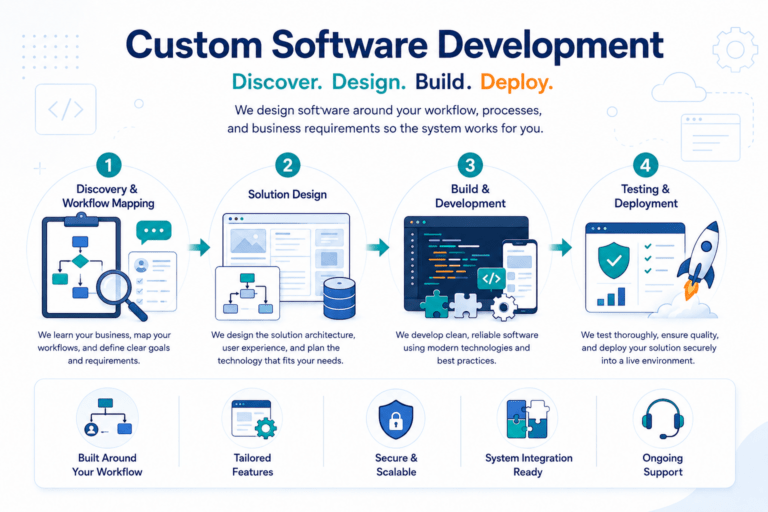
We develop custom software around the way your organisation actually operates. The process begins with understanding the workflow, users, business rules and required outcomes before designing the technical solution.
Our development process moves from discovery and workflow mapping through solution design, development, testing and controlled deployment.
The objective is not simply to produce software. It is to deliver a secure, maintainable system that solves the defined operational problem and can evolve as requirements change.

Replace Workarounds with a Proper System

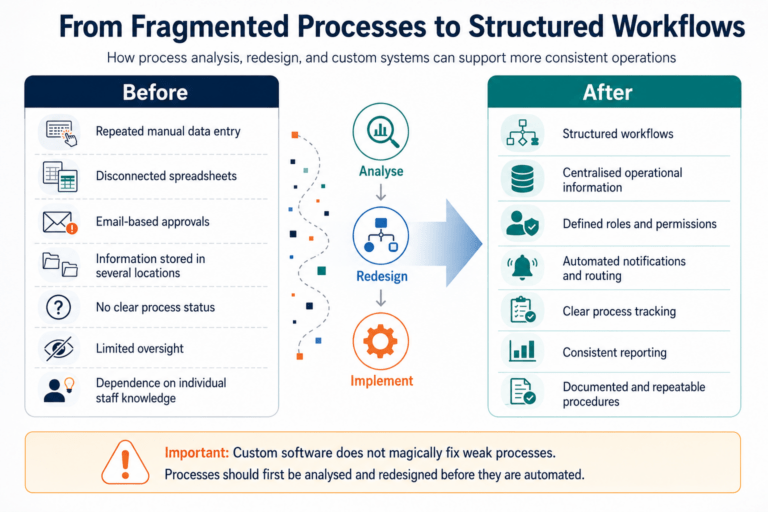
Many organisations are not actually using one system. They are using a collection of spreadsheets, email chains, shared folders, manual checklists and disconnected applications held together by staff knowledge.
That is fragile. It wastes time, hides errors and creates dependency on individuals remembering how everything works.

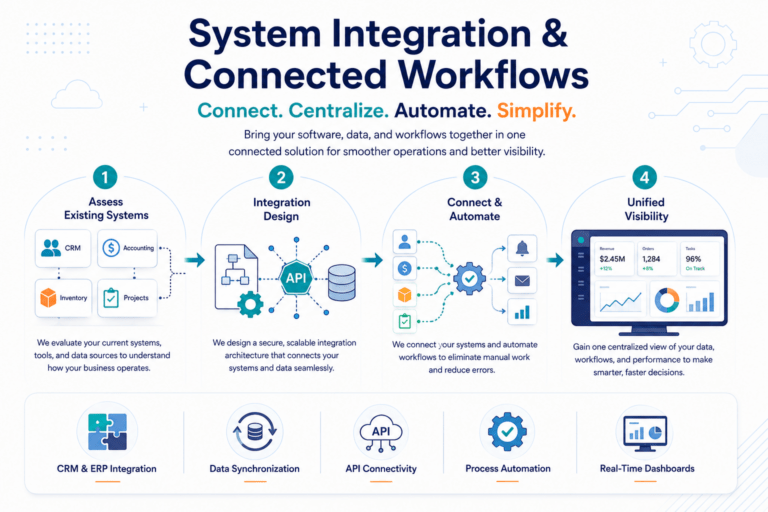
Systems Integration and Connected Workflows

Your organisation may rely on several systems for finance, customer management, projects, documents, inventory, reporting and communication.
Those platforms do not necessarily need to be replaced. In many cases, the smarter solution is to connect them so that approved information can move between systems without unnecessary manual work.
We assess your existing platforms, data sources and operational processes before designing an integration that connects the relevant systems through APIs, scheduled synchronisation or controlled data exchanges.
The result is a more connected environment with less duplication, clearer information flow and improved operational visibility.

API Integration

● Connect systems through supported and authenticated application programming interfaces.

Data Synchronisation

● Keep approved information consistent across connected platforms through controlled synchronisation.

Workflow Automation

● Trigger actions, notifications and updates when defined business events occur.

Document-System Integration

● Connect business applications to document and records management platforms where required.

Database Integration

● Exchange approved information between databases and operational applications.

Import and Export Automation

● Replace repetitive manual file handling with controlled data-transfer processes.

Centralised Operational Views

● Bring selected information from connected systems into one practical interface.

Legacy-System Connectivity

● Where technically possible, connect older systems to modern applications without immediately replacing the entire environment.

Connected Does Not Mean Monolithic

The goal is not to force every business function into one enormous application.
A better architecture may involve several specialised systems connected through controlled services and shared workflows. Each platform continues doing the work it handles well, while integrations reduce unnecessary duplication and provide a more unified user experience.

Examples of Custom Business Solutions

Data Capture and Processing

● Capture structured information, validate required fields and route submissions through defined processes.

Case and Project Management

● Track cases, tasks, responsibilities, documents, deadlines and status changes.

Operational Dashboards

● Provide approved users with practical summaries of current work, exceptions and performance indicators.

Client Portals

● Allow clients or external users to submit information, upload documents and track approved interactions.

Internal Administration Systems

●  Replace fragmented spreadsheets and manual registers with controlled business applications.

Document Workflows

●  Manage document intake, review, approval, classification and handover to document-management systems.

Reporting Systems

●  Generate structured operational reports from validated information.

Integration Hubs

●  Coordinate data exchange between multiple authorised applications and services.

Secure by Design

Custom software and integration projects must account for security, access, data protection and operational reliability from the start.

Authentication

● Require approved users to verify their identity before accessing the system.

Role-Based Permissions

● Restrict data and functions according to assigned responsibilities.

Audit Logging

● Record important activities and changes where accountability is required.

Audit Logging

● Record important activities and changes where accountability is required.

Secure APIs

● Protect integrations through authentication, authorisation and controlled endpoints.

Backup and Recovery

● Define appropriate backup and recovery measures for the deployed environment.

Monitoring

● Monitor application and integration failures according to the agreed support scope.

Data Protection

● Design the solution around applicable organisational and legal data-handling requirements.

How We Deliver Your Solution

1. Understand the Operation

● We examine the existing workflow, users, systems, pain points and business requirements.

2. Design the Solution

● We define the architecture, data model, interfaces, permissions and integration approach.

3. Build and Validate

● We develop the solution and test it against representative workflows and acceptance criteria.

4. Deploy and Support

● We deploy the approved system and provide ongoing support or enhancements according to the agreed service scope.
Common Questions

Find answers to your frequent questions about SharePoint EDRMS.

We develop custom web applications, internal business systems, data-capture platforms, reporting tools, portals, workflow systems and integration services.

Not necessarily. We first assess whether the existing platforms can be integrated or improved before recommending replacement.

Potentially, yes. Integration depends on whether the platforms provide supported APIs, database access, export mechanisms or other approved integration methods.

Yes, provided the workflow can be clearly defined and the required systems support the necessary integration or data exchange.

Browser-based systems can be designed responsively for desktop, tablet and mobile use where appropriate.

Yes. Role-based permissions can be implemented according to organisational responsibilities and information-access requirements.

Yes, if scalability and future requirements are considered during the architecture and design stage.

Hosting, monitoring, maintenance and technical support can be included according to the project and service agreement.

The cost depends on the workflow complexity, number of users, required features, integrations, security requirements and deployment environment. A proper requirements assessment is required before quoting.

Begin with the business problem, not a list of desired technology. We will assess the workflow, existing systems and intended outcome before proposing an appropriate solution.

Scroll to Top