Custom AI Development & Deployment

Plain Sailing Information Systems designs, develops and deploys task-specific AI models, intelligent agents and automated workflows built around real operational requirements.

From document processing and handwriting recognition to computer vision, structured extraction and secure API deployment, we build AI solutions that perform defined work inside real business processes.

AI Built for Real Business Problems

AI delivers value when it is designed around a specific task, a clear workflow and a measurable outcome.
We do not force generic chatbot technology into unsuitable processes.We assess the business problem, determine whether AI is appropriate, and develop a controlled solution around the organisation’s data, systems and operational requirements.

Custom AI Development

Task-specific models and intelligent agents designed around clearly defined use cases.

Business AI Applications

Document AI, extraction, handwriting recognition, summarisation, computer vision and workflow automation

Secure Deployment

AI services integrated with business systems through controlled APIs and GPU-backed infrastructure.
Custom AI Development

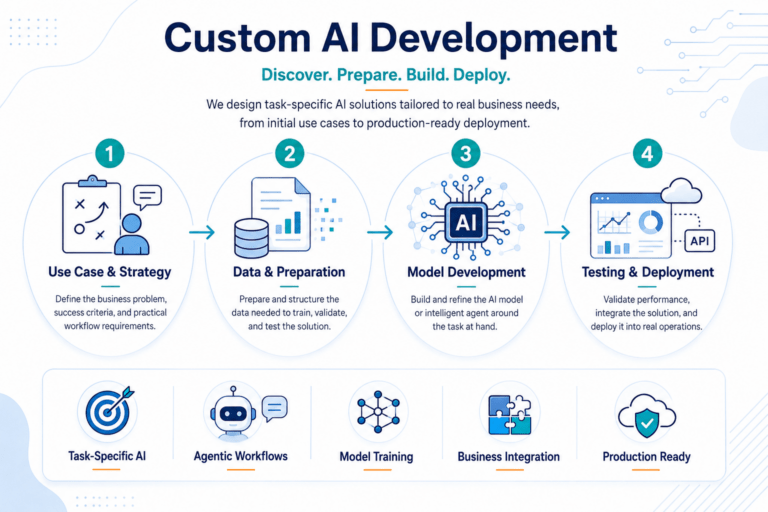
A successful AI project begins with the business problem not the model.
We define the intended task, success criteria, data requirements, operational controls and integration requirements before development begins.
Our development process moves from use-case definition and data preparation through model development, testing, integration and production deployment.
The objective is not to produce an impressive demonstration. It is to deliver an AI system that performs useful work reliably within a real operational environment.

Use-Case Definition

● Identify the task, expected outcome, users, risks and measurable acceptance criteria.

Data Preparation

● Collect, structure, clean and assess the data required for training, validation and testing.

Model Development

● Develop or adapt task-specific AI models according to the defined use case.

Intelligent Agents

● Build controlled agents that can analyse information, execute approved tasks and interact with connected systems.

Testing and Validation

● Assess accuracy, consistency, edge cases and operational suitability before deployment.

Production Deployment

● Integrate and deploy the model into a controlled environment suitable for actual use.
AI Solutions and Business Applications

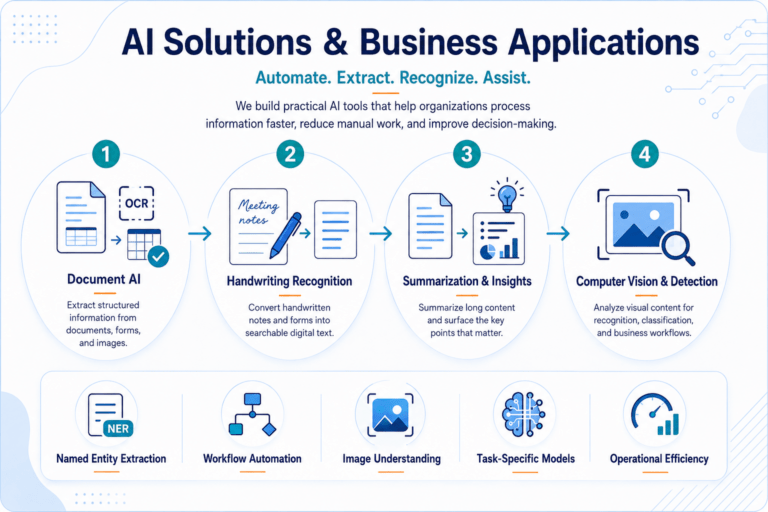
We develop practical AI tools that help organisations process information, reduce repetitive work and improve the consistency of defined tasks.
Our focus is specialised AI, not general-purpose language models pretending to solve every problem.
Each solution is designed around the type of information being processed, the required output and the business workflow in which the result will be used.

Document AI

● Classify documents, identify document types, extract metadata and convert unstructured content into usable information.

Handwriting Recognition

● Recognize handwritten text from forms, notes, registers and archival documents.

Structured Data Extraction

● Extract defined fields from invoices, reports, forms, correspondence and other document types.

Named Entity Recognition

● Identify people, organisations, locations, dates, reference numbers and other important entities within text.

Document Summarization

● Generate controlled summaries of longer documents while retaining links to the original source.

OCR and Image Analysis

● Extract printed text and analyze scanned or photographed documents.

Computer Vision

● Detect, classify and interpret objects, conditions and patterns within images or video.

Workflow Automation

● Use AI outputs to support routing, validation, review and multi-stage operational processes.

AI Agents

● Develop agents that perform specific tasks using controlled tools, data sources and business rules.

Quality Control and Validation

● Apply automated checks, confidence thresholds and human-review requirements to improve consistency.

Secure AI Deployment and Integration

An AI model sitting alone in a test environment is not a complete business solution.
The real value comes from connecting it to the systems, workflows and users that need the result. We deploy AI services through secure APIs and controlled infrastructure so they can operate as part of an existing business process.
Our deployment approach covers integration, infrastructure, governance, monitoring and operational controls required for production use.

Systems Integration

● Connect AI services to websites, web applications, databases, document-management systems and internal platforms.

Secure APIs

● Expose AI capabilities through authenticated and controlled API endpoints.

GPU-Backed Infrastructure

● Deploy computationally demanding AI workloads on suitable GPU infrastructure.

Private Deployment

● Where required, deploy AI services in environments designed to keep organisational data under controlled access.

Governance and Auditability

● Record model versions, processing events, confidence scores, user actions and review outcomes where required.

Human Review

● Route low-confidence or high-risk results for validation before they are accepted or acted upon.

Monitoring

● Monitor usage, failures, processing times, model behaviour and operational performance.

Continuous Improvement

● Refine models and workflows based on validated feedback, new data and changing requirements.

AI Agents Built Around Your Workflow

We develop controlled AI agents that can analyse information, use approved tools, interact with authorised systems and complete defined multi-step tasks.
Unlike a generic chatbot, an agent is designed around a specific process, set of permissions and expected outcome.

● Document intake and classification

● Data extraction and validation

● Information retrieval

● Report preparation

● Workflow routing

● Quality-control checks

● Structured research tasks

● Internal knowledge assistance

How we work

1. Define the Problem

● Identify the operational task, users, risks, expected outcome and acceptance criteria.

2. Assess the Data

● Review the available data, quality, structure, permissions and suitability.

3. Build and Test

● Develop the model or agent and validate it using representative data.

4. Integrate and Deploy

● Connect the solution to approved systems and deploy it in a controlled environment.

5. Monitor and Improve

● Measure performance, review failures and refine the model and workflow over time.
Common Questions

Find answers to your frequent questions about SharePoint EDRMS.

We develop task-specific models, AI agents, document-processing systems, extraction tools, handwriting-recognition systems, computer-vision solutions and automated workflows.

Our focus is generally not on building general-purpose large language models from the ground up. We develop or adapt specialised models and workflows for defined business tasks.

Potentially, yes. The data must first be assessed for quality, relevance, permissions, security and suitability for the intended task.

Yes. AI services can be connected to websites, applications, databases, document-management platforms and other systems through APIs and controlled integrations.

Yes. Depending on the project, we can deploy AI services on suitable infrastructure, including GPU-backed environments.

Data handling and access controls must be defined for each implementation. Private deployment, authenticated APIs, role-based access and audit controls can be included where required.

No. AI outputs can contain errors. Proper testing, confidence thresholds, human review and acceptance controls are required according to the risk of the task.

Yes. Support can include monitoring, troubleshooting, model updates, performance review and workflow improvements according to the agreed service scope.

Start with a clearly defined operational problem. We will assess the use case, available data, integration requirements and expected outcome before proposing a solution.

Scroll to Top